
 By
By Artificial Intelligence (AI) has become one of the most transformative technologies of the 21st century. From writing emails and creating artwork to diagnosing diseases and driving business decisions, AI is changing how people live and work. Its ability to process massive amounts of information in seconds has made it an invaluable tool for individuals, businesses, educators, and governments.
However, as AI becomes more powerful and accessible, a growing concern is emerging: over-reliance on artificial intelligence. While AI offers incredible benefits, depending on it too heavily can have serious consequences for critical thinking, creativity, privacy, employment, education, and society as a whole.
The real question is no longer whether AI is useful—it clearly is. The question is whether we are using it wisely.
What Does Over-Reliance on AI Mean?
Over-reliance on AI occurs when individuals or organizations depend on artificial intelligence to perform tasks that require human judgment, creativity, ethical reasoning, or decision-making without adequate human oversight.
Instead of using AI as a helpful assistant, people begin treating it as a replacement for their own thinking and expertise. This can lead to poor decisions, misinformation, and reduced human capability over time.
1. Decline in Critical Thinking Skills
One of the greatest dangers of excessive AI dependence is the gradual loss of critical thinking.
When people automatically accept AI-generated answers without questioning their accuracy, they stop analyzing information independently. Students may rely on AI to complete assignments instead of understanding concepts, while professionals may accept AI-generated reports without verifying the facts.
Critical thinking is developed through questioning, researching, comparing evidence, and solving problems—not by simply accepting machine-generated responses.
If this trend continues, future generations may become less capable of independent reasoning.
2. Reduced Creativity
Creativity comes from imagination, emotions, experiences, and original thought.
Although AI can generate impressive content, music, designs, and code, it primarily works by identifying patterns from existing data. It does not experience life, emotions, or personal growth.
When creators rely entirely on AI for writing, designing, composing music, or producing art, originality can suffer. Over time, creative industries risk becoming saturated with similar-looking and repetitive content.
The world’s greatest innovations have always come from human curiosity, not algorithms alone.
3. Spread of Misinformation
AI systems are not perfect.
They sometimes produce incorrect information, outdated facts, fabricated references, or misleading explanations with great confidence. This phenomenon is often referred to as “AI hallucination.”
If users fail to verify AI-generated information, false claims can spread rapidly through social media, news articles, classrooms, and workplaces.
This becomes particularly dangerous in areas such as:
- Medicine
- Law
- Finance
- Journalism
- Scientific research
- Public policy
Fact-checking remains an essential human responsibility.
4. Job Displacement and Skill Erosion
AI automation is transforming industries around the world.
Many repetitive and routine tasks are now performed faster by AI systems than by humans. While automation creates new opportunities, it also reduces demand for certain types of work.
An even greater concern is skill erosion.
For example:
- Writers who allow AI to write everything may gradually lose their writing ability.
- Programmers who never practice coding may forget important programming concepts.
- Designers who rely entirely on AI-generated graphics may lose their artistic skills.
- Students who always use AI to solve homework may struggle during examinations or real-world problem-solving.
Skills improve through practice—not delegation.
5. Privacy and Data Security Risks
Many AI applications require users to submit information in order to generate useful responses.
This may include:
- Personal information
- Business documents
- Financial records
- Medical data
- Legal contracts
- Confidential company information
Uploading sensitive information to AI platforms without understanding how the data is stored or processed can create significant privacy risks.
Organizations should establish clear policies regarding what information can safely be shared with AI systems.
6. Ethical and Moral Challenges
AI does not possess morals, empathy, or conscience.
It generates responses based on patterns in data rather than ethical reasoning.
Important decisions involving healthcare, criminal justice, employment, education, or national security should never rely solely on AI recommendations.
Human oversight is necessary because ethical decisions often require compassion, fairness, cultural understanding, and accountability.
7. Increased Bias and Discrimination
AI learns from historical data.
If that data contains bias, discrimination, or unequal representation, AI systems may unintentionally reproduce those same biases.
Examples include:
- Hiring algorithms favoring certain groups
- Facial recognition systems performing poorly for some populations
- Loan approval systems showing unfair patterns
- Predictive policing tools disproportionately affecting communities
Human review is essential to identify and correct these biases.
8. Dependence Can Reduce Learning
Education is meant to build knowledge and understanding.
When students ask AI to complete essays, solve mathematics, or answer examination questions without learning the underlying concepts, they miss valuable educational experiences.
AI should support learning—not replace it.
Teachers and students should use AI to explain difficult concepts, generate practice questions, and assist with research while still engaging in independent thinking and problem-solving.
9. Loss of Human Connection
Many organizations now use AI-powered customer service, virtual assistants, and automated communication systems.
While these technologies improve efficiency, they often lack empathy and emotional intelligence.
Certain situations—such as counseling, healthcare, conflict resolution, and customer complaints—require genuine human understanding that AI cannot fully provide.
Technology should enhance human relationships rather than replace them.
10. Overconfidence in AI Decisions
Because AI often provides fast and well-written answers, users may assume those answers are always correct.
This “automation bias” can lead people to trust AI recommendations even when they are inaccurate or incomplete.
Professionals in medicine, engineering, finance, aviation, and law must always verify AI-generated recommendations before acting upon them.
Human accountability cannot be outsourced to machines.
How to Use AI Responsibly
Rather than avoiding AI, society should focus on using it responsibly.
Some best practices include:
- Treat AI as an assistant, not a replacement.
- Verify important information using trusted sources.
- Continue developing your own skills and expertise.
- Protect sensitive personal and business information.
- Apply human judgment before making important decisions.
- Encourage creativity alongside AI assistance.
- Teach digital literacy and responsible AI use in schools.
- Recognize AI’s limitations as well as its strengths.
Responsible use allows people to benefit from AI while minimizing its risks.
The Future Is Human-AI Collaboration
The future does not belong exclusively to humans or machines—it belongs to collaboration between the two.
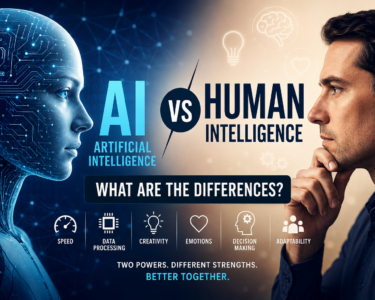
AI excels at processing data, recognizing patterns, and automating repetitive tasks. Humans excel at creativity, emotional intelligence, ethical reasoning, leadership, innovation, and complex decision-making.
The most successful individuals and organizations will be those who combine human intelligence with artificial intelligence rather than allowing one to replace the other.
Conclusion
Artificial intelligence is one of humanity’s greatest technological achievements, offering unprecedented opportunities across education, healthcare, business, science, and everyday life. Yet its growing influence also demands thoughtful and responsible use.
Over-reliance on AI can weaken critical thinking, reduce creativity, spread misinformation, erode valuable skills, compromise privacy, and create ethical challenges. These risks highlight an important truth: AI is a powerful tool, but it is not a substitute for human judgment, experience, or wisdom.
The goal should not be to fear AI or reject it. Instead, we should embrace it as a partner that enhances human potential while preserving the qualities that make us uniquely human. By maintaining curiosity, questioning AI-generated information, protecting our skills, and placing people at the center of important decisions, we can enjoy the benefits of artificial intelligence without sacrificing our independence or creativity.
Ultimately, the future belongs not to those who depend entirely on AI, but to those who know when to use it—and when to trust their own minds.