
 By
By Introduction
Artificial Intelligence (AI) is no longer a futuristic concept confined to science fiction. It has become one of the most transformative technologies of the 21st century, reshaping industries, redefining careers, and revolutionizing the way people work. From automating repetitive tasks to assisting with complex decision-making, AI is changing the future of work faster than anyone could have imagined.
Businesses of every size—from startups to multinational corporations—are embracing AI-powered solutions to increase productivity, reduce operational costs, and deliver better customer experiences. Meanwhile, employees are adapting to new tools that enhance efficiency while creating entirely new career opportunities.
But what does this transformation really mean for workers, employers, entrepreneurs, and society?
In this comprehensive guide, we’ll explore how Artificial Intelligence is changing the future of work, the benefits and risks of AI adoption, the industries experiencing the biggest transformations, and how individuals can prepare for an AI-driven future.
What Is Artificial Intelligence?
Artificial Intelligence refers to computer systems designed to perform tasks that typically require human intelligence. These tasks include:
- Learning from data
- Understanding language
- Recognizing images
- Solving problems
- Making predictions
- Automating decisions
- Generating content
- Writing computer code
Modern AI technologies include:
- Machine Learning (ML)
- Deep Learning
- Natural Language Processing (NLP)
- Computer Vision
- Robotics
- Generative AI
Examples include ChatGPT, AI-powered customer support systems, recommendation engines, self-driving technologies, and intelligent automation software.
Why AI Is Transforming the Workplace
Unlike previous technological revolutions that mainly replaced physical labor, AI enhances or automates both physical and intellectual work.
Organizations are adopting AI because it helps them:
- Reduce costs
- Improve efficiency
- Make faster decisions
- Personalize customer experiences
- Increase productivity
- Analyze massive datasets
- Improve accuracy
- Operate around the clock
As AI capabilities continue to improve, businesses are discovering new ways to integrate intelligent systems into everyday operations.
How Artificial Intelligence Is Changing the Future of Work
1. Automating Repetitive Tasks
One of AI’s biggest impacts is automating repetitive and time-consuming work.
Examples include:
- Data entry
- Invoice processing
- Scheduling appointments
- Email sorting
- Inventory management
- Customer support
- Payroll processing
Instead of spending hours on routine tasks, employees can focus on higher-value work that requires creativity, communication, and strategic thinking.
2. Creating New Job Opportunities
While many fear AI will eliminate jobs, history shows that technological advancements often create new professions.
Some rapidly growing AI-related careers include:
- AI Engineer
- Prompt Engineer
- Machine Learning Specialist
- Data Scientist
- AI Ethics Consultant
- AI Product Manager
- Robotics Technician
- AI Trainer
- Automation Consultant
- AI Security Specialist
Even traditional professions are evolving to include AI expertise.
3. Increasing Workplace Productivity
AI enables employees to complete tasks faster than ever before.
Examples include:
- Writing reports in minutes
- Summarizing lengthy documents
- Creating presentations
- Analyzing business data
- Drafting emails
- Scheduling meetings
- Generating marketing campaigns
- Producing software code
Rather than replacing workers, AI often serves as a powerful productivity assistant.
4. Revolutionizing Customer Service
Many companies now use AI chatbots and virtual assistants that provide instant support.
Benefits include:
- 24/7 availability
- Faster response times
- Lower operational costs
- Personalized recommendations
- Reduced waiting times
Human agents still handle complex situations while AI resolves routine inquiries.
5. Improving Decision-Making
Modern organizations generate enormous amounts of data every day.
AI helps leaders by:
- Detecting trends
- Predicting customer behavior
- Forecasting sales
- Identifying business risks
- Optimizing pricing strategies
- Improving supply chain management
Data-driven decisions are becoming more accurate thanks to intelligent algorithms.
6. Transforming Remote Work
Remote work has become significantly more efficient because of AI.
AI-powered tools assist with:
- Meeting transcription
- Language translation
- Task management
- Smart scheduling
- Virtual collaboration
- Project planning
- Automated note-taking
Distributed teams can collaborate more effectively regardless of location.
7. Personalizing Employee Learning
Traditional employee training often follows a one-size-fits-all model.
AI enables personalized learning by:
- Identifying skill gaps
- Recommending courses
- Tracking progress
- Creating adaptive learning paths
- Measuring performance improvements
This helps employees continuously improve their skills.
Industries Being Transformed by AI
Healthcare
AI helps healthcare professionals:
- Detect diseases earlier
- Analyze medical images
- Assist with diagnosis
- Discover new drugs
- Monitor patients remotely
Doctors increasingly use AI as a decision-support tool rather than a replacement.
Finance
Banks and financial institutions use AI for:
- Fraud detection
- Credit scoring
- Risk management
- Customer service
- Investment analysis
- Automated trading
Financial operations have become faster and more secure.
Education
Educational institutions now use AI for:
- Personalized tutoring
- Automated grading
- Learning analytics
- Course recommendations
- Virtual teaching assistants
Students benefit from more customized learning experiences.
Manufacturing
Factories use AI-powered robots to:
- Assemble products
- Detect defects
- Predict equipment failures
- Improve quality control
- Optimize production
This increases efficiency while reducing waste.
Retail
Retail businesses leverage AI to:
- Predict customer demand
- Recommend products
- Optimize inventory
- Personalize marketing
- Improve pricing strategies
Consumers receive better shopping experiences both online and offline.
Marketing
Digital marketers increasingly rely on AI for:
- Content generation
- SEO optimization
- Audience segmentation
- Social media management
- Email marketing
- Advertising optimization
AI helps marketers create more targeted campaigns.
Benefits of AI in the Workplace
Organizations adopting AI often experience:
Increased Productivity
Employees complete tasks more efficiently.
Better Accuracy
AI reduces human error in repetitive processes.
Lower Costs
Automation decreases labor-intensive expenses.
Faster Innovation
Businesses can develop products and services more quickly.
Improved Customer Satisfaction
Customers receive quicker and more personalized service.
Enhanced Data Analysis
AI identifies patterns humans may overlook.
Challenges of Artificial Intelligence in the Workplace
Despite its advantages, AI presents several challenges.
Job Displacement
Certain repetitive roles may decline as automation expands.
Workers must adapt by learning new skills.
Skills Gap
Many employees lack AI-related knowledge.
Organizations need ongoing training programs to prepare their workforce.
Privacy Concerns
AI systems process vast amounts of personal and business data.
Companies must ensure compliance with privacy regulations and maintain robust cybersecurity practices.
Bias in AI
AI systems can inherit biases from the data they are trained on.
Organizations must develop fair, transparent, and accountable AI systems.
Ethical Considerations
Businesses must address questions such as:
- Should AI make hiring decisions?
- How transparent should AI systems be?
- Who is responsible when AI makes mistakes?
Responsible AI governance is becoming increasingly important.
Skills That Will Be Valuable in the AI Era
The future workforce will require a blend of technical and human skills.
Key skills include:
- Critical thinking
- Creativity
- Emotional intelligence
- Leadership
- Communication
- Problem-solving
- AI literacy
- Data analysis
- Adaptability
- Digital collaboration
Workers who continuously learn and adapt will remain highly competitive.
How Businesses Can Prepare for an AI Future
Organizations should:
- Invest in employee training
- Adopt AI gradually
- Build responsible AI policies
- Protect customer data
- Encourage innovation
- Monitor AI performance
- Foster collaboration between humans and AI
Successful businesses will view AI as a tool that enhances—not replaces—human talent.
How Individuals Can Stay Relevant
To thrive in an AI-powered workplace:
- Learn AI fundamentals
- Improve digital skills
- Take online certifications
- Build creative abilities
- Strengthen communication skills
- Develop leadership qualities
- Stay informed about emerging technologies
- Embrace lifelong learning
The willingness to learn may become one of the most valuable career assets.
Will AI Replace Human Workers?
The more realistic outcome is that AI will reshape jobs rather than eliminate work altogether. Routine tasks are likely to become increasingly automated, while roles requiring empathy, creativity, ethical judgment, leadership, negotiation, and complex problem-solving will continue to depend heavily on people.
Workers who use AI as a collaborative tool are likely to be more productive and competitive than those who avoid it.
The Future of Work: Humans and AI Working Together
The future workplace will likely combine human creativity with AI efficiency.
Imagine workplaces where:
- AI handles repetitive administrative work.
- Humans focus on innovation and strategy.
- Teams make decisions with AI-powered insights.
- Employees receive personalized career development.
- Businesses deliver faster, smarter, and more personalized services.
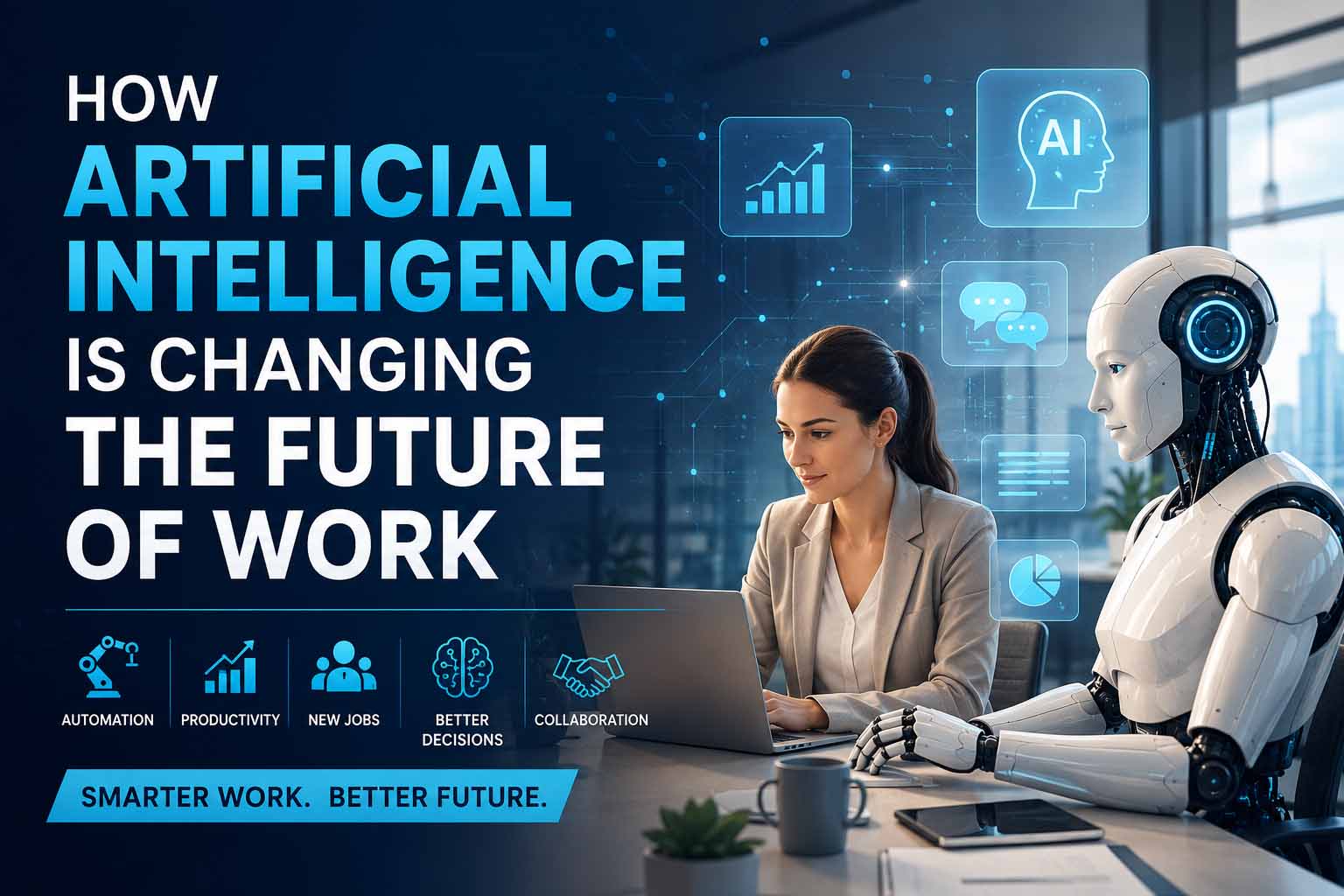
This human-AI partnership has the potential to improve productivity while creating new opportunities across industries.
Frequently Asked Questions (FAQs)
How is Artificial Intelligence changing the future of work?
AI is automating routine tasks, improving productivity, creating new careers, enhancing decision-making, and transforming industries through intelligent technologies.
Will AI replace all jobs?
No. AI is expected to automate specific tasks rather than eliminate every occupation. Many roles will evolve, and entirely new jobs will continue to emerge.
Which industries are most affected by AI?
Healthcare, finance, manufacturing, retail, education, transportation, marketing, customer service, logistics, and software development are among the sectors experiencing significant AI-driven change.
What skills are most important for the AI era?
Critical thinking, creativity, communication, emotional intelligence, adaptability, AI literacy, and digital skills will be increasingly valuable.
Can small businesses benefit from AI?
Yes. AI tools can help small businesses automate repetitive work, improve customer service, generate marketing content, analyze data, and reduce operational costs without requiring large budgets.
Conclusion
Artificial Intelligence is transforming the future of work at an unprecedented pace. Rather than viewing AI as a threat, businesses and professionals should see it as a powerful tool that enhances human capabilities, drives innovation, and unlocks new opportunities.
Success in the AI era will belong to organizations that embrace responsible adoption and to individuals who commit to continuous learning. As AI continues to evolve, the most resilient workers will be those who combine technical knowledge with creativity, adaptability, and strong interpersonal skills.
The future of work is not about humans versus machines—it is about humans and intelligent technologies working together to build smarter, more productive, and more innovative workplaces.