
 By
By Artificial Intelligence (AI) is transforming nearly every aspect of modern life. From self-driving cars and intelligent chatbots to medical diagnosis and content creation, AI has become one of the most influential technologies of the 21st century.
As AI continues to evolve, one question remains at the center of public debate:
How different is artificial intelligence from human intelligence?
Can machines truly think like humans? Will AI eventually replace people? Or is AI simply a powerful tool designed to complement human abilities?
In this comprehensive guide, we’ll explore the major differences between AI and human intelligence, their strengths and weaknesses, and what the future holds for both.
What Is Artificial Intelligence?
Artificial Intelligence (AI) refers to computer systems that are designed to perform tasks that normally require human intelligence.
These tasks include:
- Learning from data
- Solving problems
- Recognizing speech
- Understanding language
- Identifying images
- Making predictions
- Automating repetitive work
- Generating content
Unlike humans, AI doesn’t possess consciousness or self-awareness. Instead, it relies on algorithms, mathematical models, and massive amounts of data to produce results.
Examples include:
- Virtual assistants
- Recommendation systems
- Autonomous vehicles
- Medical diagnostic software
- AI-powered search engines
- Image generation tools
- Language models
What Is Human Intelligence?
Human intelligence is the natural ability of people to learn, reason, understand, imagine, adapt, communicate, and solve problems.
It is influenced by:
- Experience
- Emotions
- Culture
- Education
- Creativity
- Ethics
- Intuition
- Social interaction
Unlike AI, humans are capable of independent thought, emotional understanding, imagination, and moral judgment.
Human intelligence has evolved over millions of years, allowing people to innovate, build civilizations, create art, and develop meaningful relationships.
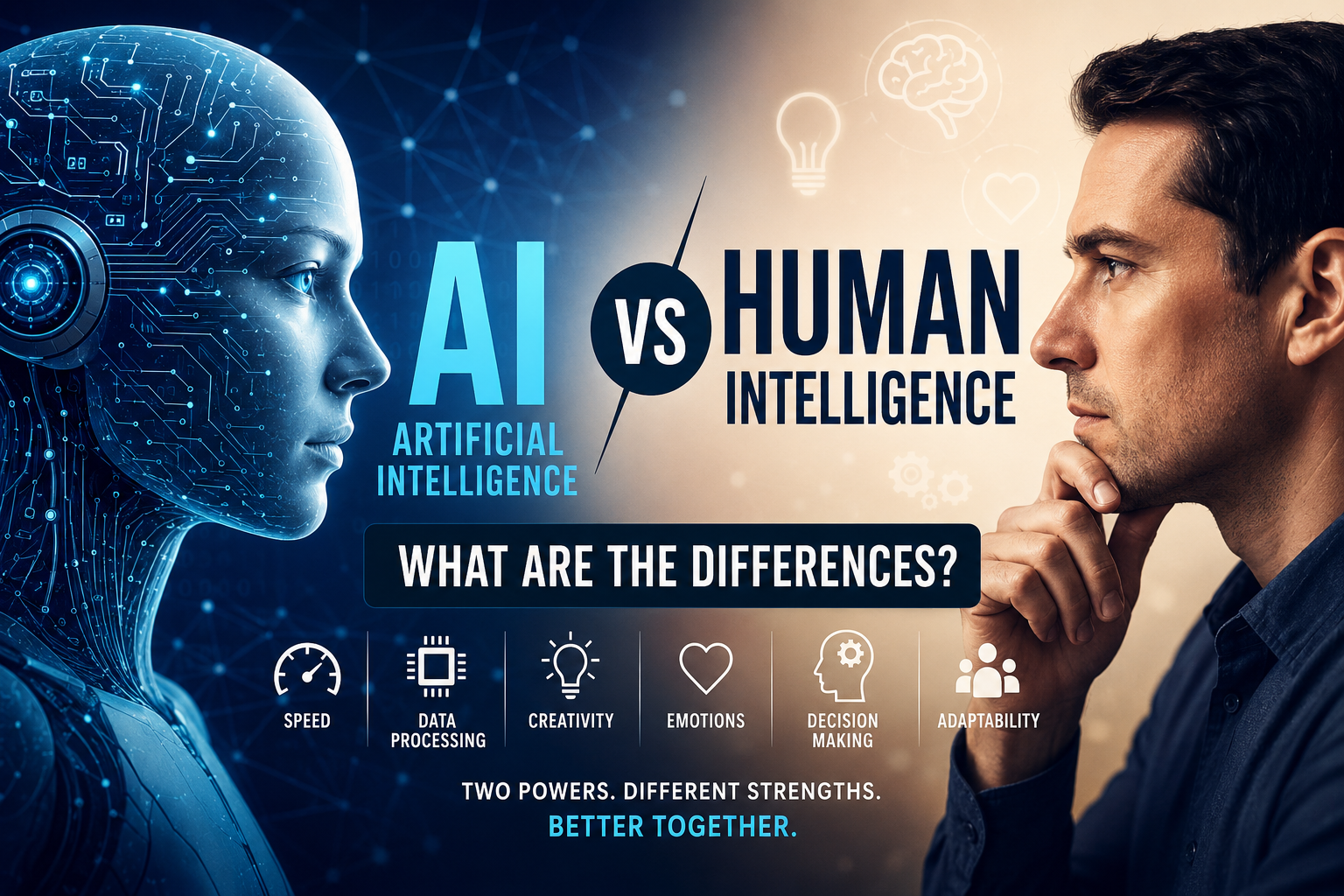
AI vs Human Intelligence: Quick Comparison
| Feature | Artificial Intelligence | Human Intelligence |
|---|---|---|
| Learning | Learns from data | Learns from experiences |
| Speed | Extremely fast | Relatively slower |
| Creativity | Pattern-based | Original imagination |
| Emotions | None | Rich emotional intelligence |
| Decision Making | Data-driven | Logic + intuition + emotions |
| Memory | Massive digital storage | Biological memory |
| Adaptability | Limited to programming | Highly adaptable |
| Common Sense | Weak | Strong |
| Consciousness | No | Yes |
| Ethics | Programmed | Personal moral judgment |
| Fatigue | Never gets tired | Needs rest |
| Accuracy | High for specific tasks | Can make mistakes |
1. Learning Ability
One of the biggest differences lies in how AI and humans learn.
AI Learning
Artificial intelligence learns through:
- Machine learning
- Deep learning
- Neural networks
- Training datasets
The more high-quality data AI receives, the better it becomes at specific tasks.
However, AI cannot truly understand concepts the way humans do.
It identifies patterns rather than comprehending meaning.
Example
An AI can recognize millions of cat photos.
But it doesn’t actually know what a cat is.
It simply recognizes visual patterns associated with cats.
Human Learning
Humans learn through:
- Observation
- Experience
- Conversation
- Curiosity
- Mistakes
- Emotion
A child may only see a few cats before understanding what makes something a cat—even in unfamiliar situations.
Humans generalize knowledge far better than AI.
2. Creativity
People often assume AI is creative because it can write articles, generate music, or create artwork.
However, AI creativity is fundamentally different.
AI Creativity
AI creates by combining patterns learned from existing data.
It predicts what is statistically likely to come next.
It does not imagine.
It recombines.
Human Creativity
Human creativity comes from:
- Emotions
- Personal experiences
- Dreams
- Curiosity
- Imagination
- Inspiration
Humans invent entirely new ideas without relying solely on previous patterns.
That is why groundbreaking inventions, literature, and scientific discoveries continue to originate from human minds.
3. Emotional Intelligence
This is perhaps the greatest difference.
AI
AI can recognize emotional cues from:
- Voice
- Facial expressions
- Written language
But it does not actually feel emotions.
It only predicts emotional states.
Humans
Humans experience:
- Love
- Happiness
- Fear
- Compassion
- Empathy
- Grief
- Excitement
- Hope
These emotions influence relationships, leadership, teamwork, and decision-making.
Emotional intelligence remains one of humanity’s greatest strengths.
4. Decision-Making
AI Decisions
AI makes decisions based on:
- Historical data
- Algorithms
- Statistical probabilities
It excels in environments where clear rules exist.
Examples include:
- Fraud detection
- Medical image analysis
- Route optimization
- Financial forecasting
Human Decisions
Humans combine:
- Logic
- Ethics
- Intuition
- Values
- Emotions
- Experience
Many real-life situations involve uncertainty where data alone is insufficient.
This is where humans outperform AI.
5. Speed
AI is dramatically faster.
An AI system can analyze millions of records in seconds.
Humans may need weeks or months to review the same amount of information.
This makes AI invaluable for:
- Healthcare
- Banking
- Manufacturing
- Scientific research
- Cybersecurity
6. Memory
AI can store enormous amounts of information indefinitely.
Humans have biological memory, which is flexible but imperfect.
People forget details.
AI generally does not unless its data is removed or corrupted.
7. Adaptability
Humans adapt remarkably well.
A person can:
- Move to another country
- Learn a new language
- Change careers
- Survive unexpected situations
AI is far less adaptable outside the tasks it has been trained to perform.
An AI trained to detect cancer cannot suddenly become a lawyer without extensive retraining.
8. Common Sense
Humans naturally understand context.
AI still struggles with common sense.
For example:
If someone says,
“I left my phone in the fridge.”
Humans instantly realize this is unusual.
AI may interpret the sentence literally unless it has learned from similar examples.
9. Ethics and Morality
Humans constantly make moral judgments.
Examples include:
- Honesty
- Fairness
- Compassion
- Justice
AI has no personal values.
It follows objectives defined by developers and organizations.
Responsible AI development requires human oversight to ensure fairness, transparency, and accountability.
10. Problem Solving
AI performs exceptionally well on narrow, well-defined problems.
Humans excel at solving novel, ambiguous, and interdisciplinary challenges.
For example:
AI may defeat world champions in chess.
Humans, however, can invent entirely new games, create business models, or solve complex social issues.
Strengths of Artificial Intelligence
AI offers several major advantages:
- Processes huge amounts of data rapidly
- Operates continuously without fatigue
- Reduces repetitive manual work
- Delivers consistent performance
- Supports medical diagnosis
- Enhances scientific research
- Improves productivity
- Detects patterns humans might miss
Limitations of Artificial Intelligence
Despite rapid advances, AI has important limitations:
- No emotions
- No consciousness
- Limited common sense
- Vulnerable to biased data
- Requires large datasets
- Can produce incorrect information
- Lacks true understanding
- Cannot replace human judgment in many situations
Strengths of Human Intelligence
Humans remain uniquely capable of:
- Original creativity
- Empathy
- Moral reasoning
- Leadership
- Adaptability
- Innovation
- Critical thinking
- Complex communication
- Cultural understanding
- Building meaningful relationships
Can AI Replace Human Intelligence?
The short answer is:
Not completely.
AI is replacing certain tasks—not human beings as a whole.
Jobs involving repetitive, predictable work are becoming increasingly automated.
However, careers requiring creativity, emotional intelligence, strategic thinking, negotiation, leadership, and ethical judgment remain heavily dependent on people.
The future is more likely to involve collaboration than replacement.
The Future: Humans and AI Working Together
The most productive future combines the strengths of both.
AI contributes:
- Speed
- Automation
- Data analysis
- Accuracy
- Scalability
Humans contribute:
- Creativity
- Ethics
- Emotional intelligence
- Vision
- Innovation
- Leadership
Professionals who learn to work alongside AI will likely enjoy significant advantages in the years ahead.
Frequently Asked Questions (FAQs)
Is AI smarter than humans?
AI is faster and more accurate for specific tasks but lacks the broad understanding, consciousness, creativity, and emotional intelligence of humans.
Can AI think like humans?
No. AI processes data and identifies patterns but does not possess genuine thoughts, awareness, or subjective experiences.
Will AI take all jobs?
No. While AI will automate many repetitive tasks, it will also create new roles and increase demand for skills such as critical thinking, creativity, leadership, and AI management.
Which is better: AI or human intelligence?
Neither is universally better. AI excels at speed and data processing, while humans excel at creativity, empathy, adaptability, and ethical reasoning. Together, they achieve better outcomes than either could alone.
Conclusion
Artificial intelligence is one of humanity’s greatest technological achievements, but it is fundamentally different from human intelligence. AI excels at analyzing vast amounts of information, automating repetitive tasks, and solving narrowly defined problems with remarkable speed and accuracy. Human intelligence, however, remains unmatched in creativity, emotional understanding, ethical judgment, adaptability, and original innovation.
Rather than viewing AI and human intelligence as competitors, it is more productive to see them as complementary strengths. As AI continues to advance, the individuals and organizations that thrive will be those that combine machine efficiency with uniquely human insight. The future belongs not to AI alone or humans alone, but to intelligent collaboration between both.