
 By
By As cyber threats continue to evolve, cybersecurity has become one of the fastest-growing and highest-paying technology careers in the world. Every day, organizations face attacks from hackers, ransomware groups, phishing campaigns, and data breaches. As a result, businesses, governments, banks, hospitals, and technology companies are investing billions of dollars to protect their digital infrastructure.
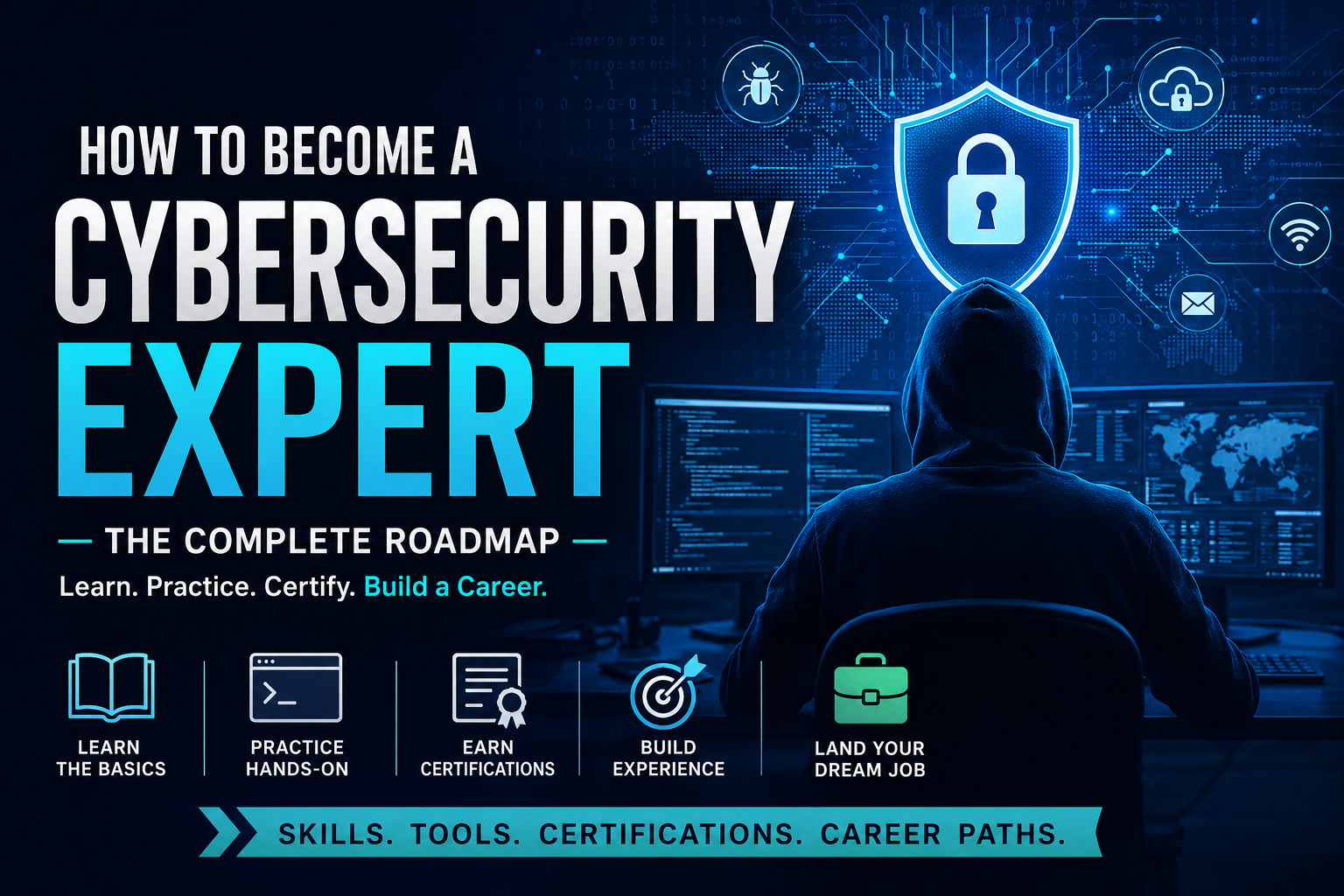
If you’re wondering how to become a cybersecurity expert, this guide will walk you through everything you need to know—from learning the fundamentals to landing your first cybersecurity job and eventually becoming an industry expert.
Whether you’re a student, IT professional, or complete beginner, this roadmap will help you build a successful cybersecurity career.
What Is Cybersecurity?
Cybersecurity is the practice of protecting computers, networks, software, cloud systems, and digital information from unauthorized access, attacks, theft, or damage.
Cybersecurity professionals identify vulnerabilities, monitor systems, prevent cyber attacks, investigate incidents, and ensure sensitive information remains secure.
Without cybersecurity experts, organizations become vulnerable to:
- Data breaches
- Identity theft
- Financial fraud
- Ransomware attacks
- Malware infections
- Insider threats
- Website hacking
- Business disruption
Why Choose a Career in Cybersecurity?
Cybersecurity is one of the few careers where demand greatly exceeds the supply of skilled professionals.
Benefits of Becoming a Cybersecurity Expert
- High salaries
- Excellent job security
- Global career opportunities
- Remote work possibilities
- Continuous learning
- Diverse career paths
- Opportunity to fight cybercrime
- High demand across industries
The cybersecurity industry continues to expand as businesses adopt cloud computing, artificial intelligence, the Internet of Things (IoT), and digital transformation initiatives.
Skills Every Cybersecurity Expert Needs
Before learning advanced security concepts, you should understand how computers and networks work.
1. Computer Fundamentals
Learn:
- Operating systems
- File systems
- Computer hardware
- Process management
- Memory management
- System administration
Recommended operating systems:
- Windows
- Linux
- macOS
Linux is especially important because many servers and security tools run on Linux.
2. Networking
Networking is the foundation of cybersecurity.
Important concepts include:
- IP addressing
- DNS
- TCP/IP
- UDP
- HTTP
- HTTPS
- FTP
- SSH
- VPN
- Firewalls
- Routers
- Switches
Understanding how data travels across networks makes it much easier to detect attacks.
3. Programming
You don’t have to become a software engineer, but basic programming knowledge is extremely valuable.
Languages worth learning include:
- Python
- JavaScript
- Bash
- PowerShell
- SQL
- C
- C++
Python is widely used for:
- Automation
- Malware analysis
- Penetration testing
- Security scripting
- Vulnerability scanning
4. Linux Administration
Linux powers much of the internet.
Learn how to:
- Navigate the terminal
- Manage files
- Configure permissions
- Install software
- Manage users
- Monitor services
- Configure SSH
5. Security Fundamentals
Core concepts include:
- Authentication
- Authorization
- Encryption
- Hashing
- Multi-factor authentication (MFA)
- Access control
- Digital certificates
- Security policies
- Risk management
Learn About Cyber Attacks
Understanding attackers helps you defend against them.
Study:
- Phishing
- Malware
- Trojans
- Worms
- Ransomware
- SQL Injection
- Cross-Site Scripting (XSS)
- Cross-Site Request Forgery (CSRF)
- Buffer overflow
- Password attacks
- Man-in-the-middle attacks
- DDoS attacks
- Zero-day exploits
Learn Ethical Hacking
Ethical hackers legally test systems for vulnerabilities before criminals exploit them.
Topics include:
- Reconnaissance
- Enumeration
- Vulnerability assessment
- Exploitation
- Privilege escalation
- Post exploitation
- Reporting
Ethical hacking helps organizations improve their security posture.
Build a Home Cybersecurity Lab
Hands-on practice is essential.
You can create your own cybersecurity lab using:
- VirtualBox
- VMware Workstation
- Hyper-V
Install practice operating systems such as:
- Kali Linux
- Ubuntu
- Windows
- Metasploitable
- OWASP Broken Web Apps
Practice:
- Penetration testing
- Network monitoring
- Malware analysis
- Log analysis
- Firewall configuration
Learn Cybersecurity Tools
Professional cybersecurity experts regularly use tools such as:
Network Analysis
- Wireshark
- tcpdump
Vulnerability Assessment
- Nessus
- OpenVAS
Penetration Testing
- Metasploit
- Burp Suite
- Nmap
- Gobuster
- Hydra
Password Testing
- John the Ripper
- Hashcat
Digital Forensics
- Autopsy
- Volatility
SIEM Platforms
- Splunk
- Microsoft Sentinel
- Elastic Security
Learn Cloud Security
Modern businesses increasingly rely on cloud computing.
Study cloud platforms such as:
- Amazon Web Services (AWS)
- Microsoft Azure
- Google Cloud Platform (GCP)
Learn about:
- Identity and Access Management (IAM)
- Cloud firewalls
- Cloud encryption
- Security monitoring
- Secure cloud architecture
Learn Incident Response
Cybersecurity professionals must know how to respond when attacks occur.
The incident response process includes:
- Preparation
- Detection
- Containment
- Eradication
- Recovery
- Lessons learned
Study Digital Forensics
Digital forensics involves investigating cyber incidents.
Topics include:
- Disk imaging
- Memory analysis
- Log analysis
- Timeline analysis
- Malware investigation
- Evidence preservation
Earn Cybersecurity Certifications
Certifications demonstrate your knowledge to employers.
Beginner Certifications
- CompTIA Security+
- Google Cybersecurity Certificate
- ISC2 Certified in Cybersecurity (CC)
Intermediate Certifications
- CompTIA CySA+
- eJPT
- CompTIA PenTest+
- SSCP
Advanced Certifications
- CISSP
- CEH
- OSCP
- CISM
- GSEC
- GIAC Certifications
Build Real Projects
Employers value practical experience.
Ideas include:
- Build a secure home network
- Create firewall rules
- Conduct vulnerability assessments
- Analyze malware samples in a safe lab
- Build Python security scripts
- Scan websites using Nmap
- Create SIEM dashboards
- Perform log analysis
Publish your work on GitHub.
Participate in Capture the Flag (CTF) Challenges
CTFs simulate real hacking scenarios.
Popular platforms include:
- Hack The Box
- TryHackMe
- PicoCTF
- OverTheWire
- PortSwigger Web Security Academy
These improve problem-solving and practical security skills.
Learn Security Frameworks
Study widely used frameworks such as:
- NIST Cybersecurity Framework
- MITRE ATT&CK
- OWASP Top 10
- ISO/IEC 27001
- CIS Controls
Understanding these frameworks helps you implement industry best practices.
Choose a Cybersecurity Career Path
Cybersecurity offers many specializations.
Popular roles include:
- Security Analyst
- SOC Analyst
- Ethical Hacker
- Penetration Tester
- Incident Responder
- Threat Intelligence Analyst
- Cloud Security Engineer
- Security Engineer
- Malware Analyst
- Application Security Engineer
- DevSecOps Engineer
- Digital Forensics Investigator
- Cybersecurity Consultant
- Chief Information Security Officer (CISO)
Gain Practical Experience
Experience can come from:
- Internships
- Freelance projects
- Volunteer work
- Open-source contributions
- Home labs
- Bug bounty programs
- Security competitions
The more practical experience you have, the stronger your resume becomes.
Stay Updated
Cybersecurity changes every day.
Stay informed by:
- Reading cybersecurity blogs
- Following security researchers
- Watching conference talks
- Listening to cybersecurity podcasts
- Practicing new attack techniques
- Learning emerging technologies
Continuous learning is essential.
Soft Skills Matter
Technical knowledge alone isn’t enough.
Develop:
- Communication
- Critical thinking
- Problem solving
- Documentation
- Teamwork
- Time management
- Analytical thinking
These skills distinguish exceptional cybersecurity professionals.
Cybersecurity Salary Expectations
Salaries vary by country, specialization, and experience.
Approximate annual ranges:
- Entry-level: $60,000–$90,000
- Mid-level: $90,000–$140,000
- Senior-level: $140,000–$220,000+
- Security Consultants and CISOs often earn significantly more depending on organization size and location.
Remote opportunities can also provide access to global employers.
Common Mistakes Beginners Make
Avoid these pitfalls:
- Skipping networking fundamentals
- Ignoring Linux
- Chasing certifications without practice
- Not building projects
- Neglecting documentation
- Giving up after difficult challenges
- Failing to stay updated
- Learning only theory
12-Month Cybersecurity Learning Roadmap
Months 1–2
- Computer fundamentals
- Networking basics
- Linux
- Python fundamentals
Months 3–4
- Security fundamentals
- Cryptography
- Firewalls
- Access control
- Authentication
Months 5–6
- Ethical hacking
- Nmap
- Wireshark
- Burp Suite
- Kali Linux
Months 7–8
- Web security
- OWASP Top 10
- Vulnerability assessment
- Penetration testing labs
Months 9–10
- Cloud security
- SIEM tools
- Incident response
- Digital forensics
Months 11–12
- Certifications
- Portfolio projects
- GitHub
- Resume
- Job applications
- Mock interviews
Frequently Asked Questions
Can I Become a Cybersecurity Expert Without a Degree?
Yes. Many cybersecurity professionals are self-taught or entered the field through certifications, practical projects, and demonstrated skills.
How Long Does It Take?
With consistent study and hands-on practice, many learners can qualify for entry-level roles within 8–18 months. Reaching an expert level typically takes several years of real-world experience and continuous learning.
Is Programming Required?
Basic programming is highly recommended, especially Python. However, many entry-level cybersecurity roles place greater emphasis on networking, operating systems, and security fundamentals.
Is Cybersecurity Difficult?
Cybersecurity can be challenging because it combines networking, operating systems, programming, and problem-solving. With persistence and regular practice, it is achievable for motivated learners.
Final Thoughts
Becoming a cybersecurity expert is a journey that combines technical knowledge, practical experience, and a commitment to continuous learning. Start with computer and networking fundamentals, master Linux and basic programming, build a home lab, earn respected certifications, and gain hands-on experience through projects and security challenges.
The cybersecurity landscape is constantly evolving, making curiosity and adaptability some of your greatest assets. Whether your goal is to become a Security Analyst, Ethical Hacker, Cloud Security Engineer, or Chief Information Security Officer, following a structured learning path and consistently sharpening your skills will position you for long-term success in one of the world’s most rewarding technology careers.
If you begin today and remain consistent, you can build a career protecting organizations, critical infrastructure, and individuals from ever-evolving cyber threats.
Secondary Keywords: