
 By
By Artificial Intelligence has rapidly evolved over the last decade, transforming industries, businesses, and everyday life. From AI-powered chatbots and self-driving vehicles to medical diagnosis systems and content generation tools, today’s AI is becoming increasingly capable.
However, experts believe that what we see today is only the beginning.
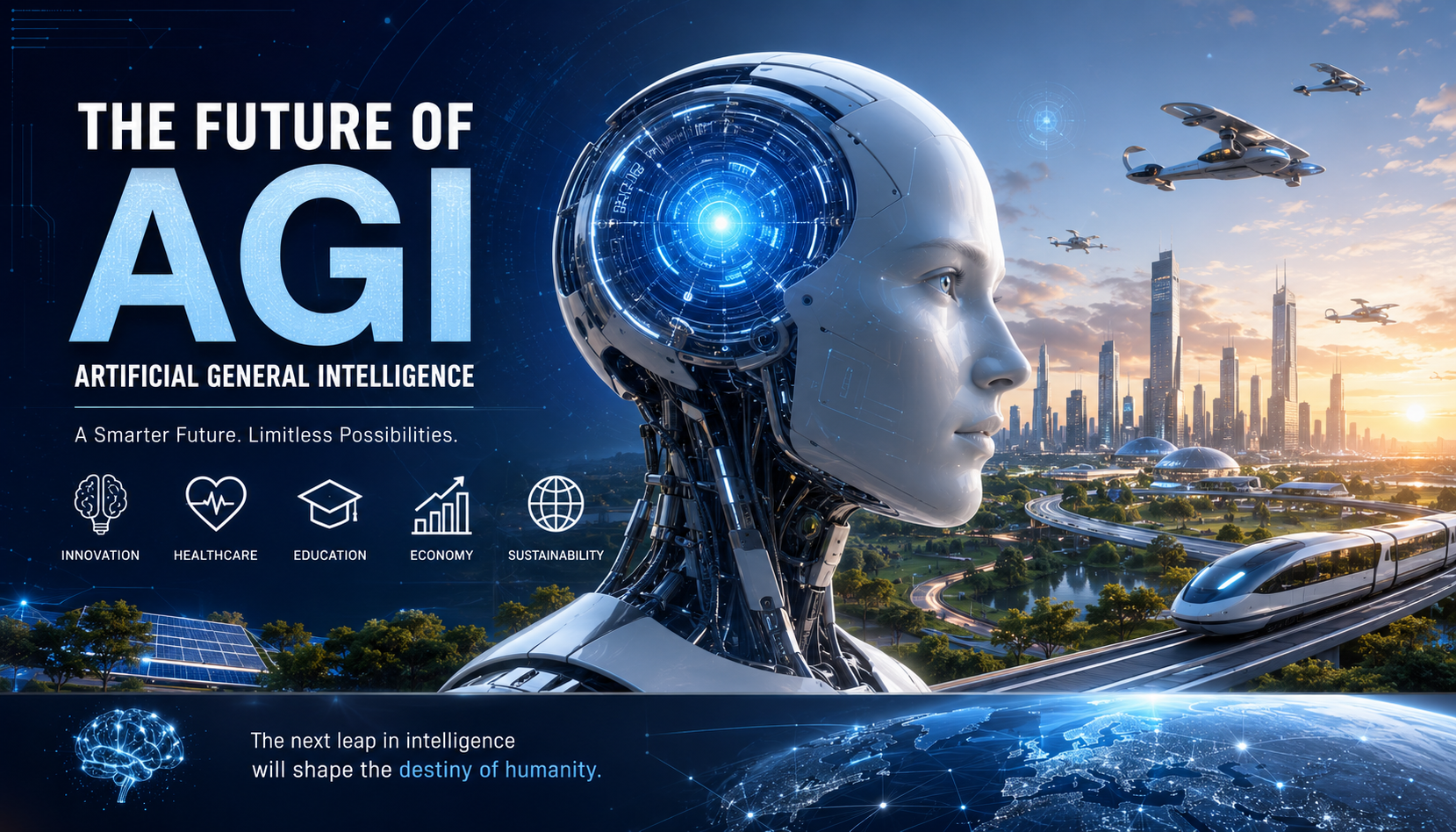
The next revolutionary milestone is Artificial General Intelligence (AGI)—a form of intelligence capable of understanding, learning, reasoning, and solving problems across virtually any domain at a human level or beyond.
But what exactly is AGI? How close are we to achieving it? What opportunities and challenges will it bring? And how can businesses and individuals prepare?
This comprehensive guide explores the future of Artificial General Intelligence and its potential impact on humanity.
What Is Artificial General Intelligence (AGI)?
Artificial General Intelligence (AGI) refers to an AI system that possesses the ability to perform any intellectual task that a human being can perform.
Unlike today’s AI systems, which are designed for specific tasks such as:
- Writing articles
- Recognizing faces
- Translating languages
- Driving vehicles
- Playing chess
- Generating images
AGI would be capable of:
- Learning completely new skills independently
- Solving unfamiliar problems
- Adapting to changing environments
- Applying knowledge across multiple disciplines
- Making complex decisions
- Understanding emotions and context more deeply
Simply put:
Current AI is specialized. AGI is generalized.
Artificial Narrow Intelligence (ANI) vs Artificial General Intelligence (AGI)
| Artificial Narrow Intelligence (ANI) | Artificial General Intelligence (AGI) |
|---|---|
| Performs specific tasks | Performs almost any intellectual task |
| Needs human training for new domains | Learns independently |
| Limited adaptability | Highly adaptable |
| Exists today | Still under development |
| Cannot truly reason like humans | Expected to reason more like humans |
Why AGI Is Considered the Next Technological Revolution
Many experts believe AGI could become one of the most significant technological breakthroughs in history.
Just as electricity transformed civilization…
Just as the internet reshaped communication…
Just as smartphones revolutionized daily life…
AGI could fundamentally redefine human society.
Its impact may exceed all previous technological revolutions combined.
How AGI Could Transform Major Industries
1. Healthcare
AGI could revolutionize medicine by:
- Discovering new drugs in days instead of years
- Predicting diseases before symptoms appear
- Creating personalized treatment plans
- Assisting surgeons with exceptional precision
- Accelerating medical research
Healthcare costs could decrease while patient outcomes improve dramatically.
2. Education
Future AGI tutors may provide:
- Personalized learning experiences
- Instant feedback
- Adaptive lesson plans
- Multilingual teaching
- 24/7 educational support
Every student could effectively have access to a private tutor.
3. Business
Companies may use AGI to:
- Optimize operations
- Forecast market trends
- Automate strategic planning
- Improve customer service
- Generate innovative business ideas
- Increase productivity
Businesses adopting AGI early could gain significant competitive advantages.
4. Scientific Research
AGI could accelerate discoveries in:
- Physics
- Chemistry
- Biology
- Astronomy
- Climate science
- Space exploration
Problems that currently require decades of research might be solved much faster.
5. Manufacturing
Factories powered by AGI could:
- Predict equipment failures
- Optimize production lines
- Reduce waste
- Improve quality control
- Lower operational costs
6. Agriculture
AGI could help farmers:
- Predict weather patterns
- Detect crop diseases early
- Improve irrigation
- Increase food production
- Reduce environmental impact
7. Finance
Banks and financial institutions could leverage AGI for:
- Fraud detection
- Risk assessment
- Investment analysis
- Financial forecasting
- Automated compliance
8. Transportation
Future transportation systems may feature:
- Fully autonomous vehicles
- Intelligent traffic management
- Optimized logistics
- Safer road networks
- More efficient public transportation
The Benefits of Artificial General Intelligence
Increased Productivity
AGI could automate complex cognitive tasks, enabling humans to focus on creativity, leadership, and innovation.
Faster Innovation
Scientific discoveries that once required decades could happen within months.
Better Decision-Making
AGI may analyze enormous datasets, helping governments and businesses make more informed decisions.
Improved Global Healthcare
Millions of lives could be saved through earlier diagnoses and improved medical research.
Economic Growth
AGI may contribute trillions of dollars to the global economy by creating new industries, improving efficiency, and enabling novel products and services.
The Risks of AGI
While AGI offers immense promise, it also raises significant concerns.
Job Displacement
Many occupations could change dramatically due to automation.
Jobs involving repetitive cognitive tasks may be particularly affected.
However, new careers are also likely to emerge.
Examples include:
- AI trainers
- AI auditors
- AI ethics specialists
- Robotics engineers
- Human-AI collaboration managers
Security Risks
Powerful AGI systems could be misused for:
- Sophisticated cyberattacks
- Automated misinformation campaigns
- Large-scale fraud
- Surveillance
Robust cybersecurity and governance will be essential.
Ethical Challenges
Questions include:
- Who controls AGI?
- Who is responsible for AGI decisions?
- How should AGI be regulated?
- What rights, if any, should advanced AI systems have?
These issues require global collaboration among governments, researchers, businesses, and civil society.
Bias and Fairness
If AGI is trained on biased data, it could perpetuate or amplify unfair outcomes.
Developers will need to prioritize fairness, transparency, and accountability.
Will AGI Replace Human Workers?
Probably not entirely.
Instead, AGI is expected to reshape work by automating some tasks while augmenting others.
Historically, technologies such as computers and the internet eliminated certain jobs but also created entirely new industries and professions.
People who learn to work effectively with AI are likely to have a significant advantage.
Skills That Will Matter in an AGI-Powered Future
As AGI advances, uniquely human capabilities are expected to become even more valuable.
These include:
- Creativity
- Critical thinking
- Emotional intelligence
- Leadership
- Communication
- Complex problem-solving
- Ethical judgment
- Adaptability
- Lifelong learning
Technical literacy—especially understanding how AI works and where it should be applied—will also become increasingly important.
Could AGI Become Smarter Than Humans?
Some researchers believe AGI could eventually surpass human intelligence in many domains, leading to what is often called Artificial Superintelligence (ASI).
Whether or when this will happen remains uncertain, and there is no scientific consensus on a timeline.
If such systems are developed, ensuring they remain aligned with human values and safety goals will be a critical challenge.
How Governments Are Preparing
Governments around the world are increasingly:
- Developing AI regulations
- Investing in AI research
- Creating ethical guidelines
- Funding AI education
- Strengthening cybersecurity
- Encouraging responsible innovation
International cooperation is likely to play an important role as AGI capabilities evolve.
How Businesses Should Prepare for AGI
Organizations can take practical steps today by:
- Investing in AI education for employees
- Experimenting with current AI tools
- Building strong data governance practices
- Developing ethical AI policies
- Enhancing cybersecurity
- Encouraging continuous learning and innovation
Preparation today can make future adoption smoother and more effective.
How Individuals Can Prepare
You don’t need to be an AI researcher to benefit from AGI.
Practical steps include:
- Learn AI fundamentals
- Explore AI productivity tools
- Build digital skills
- Strengthen creativity and communication
- Stay informed about AI developments
- Commit to continuous learning
Those who adapt to technological change are often best positioned to seize new opportunities.
Frequently Asked Questions (FAQs)
Is AGI available today?
No. Current AI systems are powerful but remain specialized. Researchers continue working toward more general-purpose AI, but fully realized AGI has not yet been achieved.
What is the difference between AI and AGI?
Today’s AI is designed for specific tasks, while AGI aims to perform a wide range of intellectual tasks with human-like flexibility and adaptability.
Will AGI eliminate all jobs?
Unlikely. AGI is expected to automate some tasks, transform many roles, and create new opportunities alongside new challenges.
Is AGI dangerous?
AGI could present risks if developed or deployed irresponsibly. Effective governance, technical safeguards, transparency, and international cooperation will be essential.
When will AGI arrive?
There is no agreed-upon timeline. Predictions from researchers vary widely, and no one can state with certainty when—or if—human-level AGI will be achieved.
Final Thoughts
Artificial General Intelligence represents one of the most ambitious goals in modern technology. While today’s AI already enhances productivity and creativity, AGI seeks to expand those capabilities into a more flexible, human-like form of intelligence.
Its potential benefits—from accelerating scientific discovery and improving healthcare to transforming education and business—are enormous. At the same time, AGI introduces important questions about ethics, governance, employment, and security that society will need to address thoughtfully.
Rather than fearing the future, individuals, businesses, and governments can prepare by investing in education, responsible innovation, and policies that encourage the safe and beneficial development of advanced AI. Whether AGI arrives in the near future or much later, staying informed and adaptable will be one of the best ways to thrive in an AI-driven world.