
 By
By As cybercrime continues to rise across the globe, organizations are investing billions of dollars to secure their digital assets. One of the most effective ways to protect systems from cyberattacks is through ethical hacking.
Unlike malicious hackers who steal information or damage systems, ethical hackers use their skills legally to identify vulnerabilities before cybercriminals can exploit them.
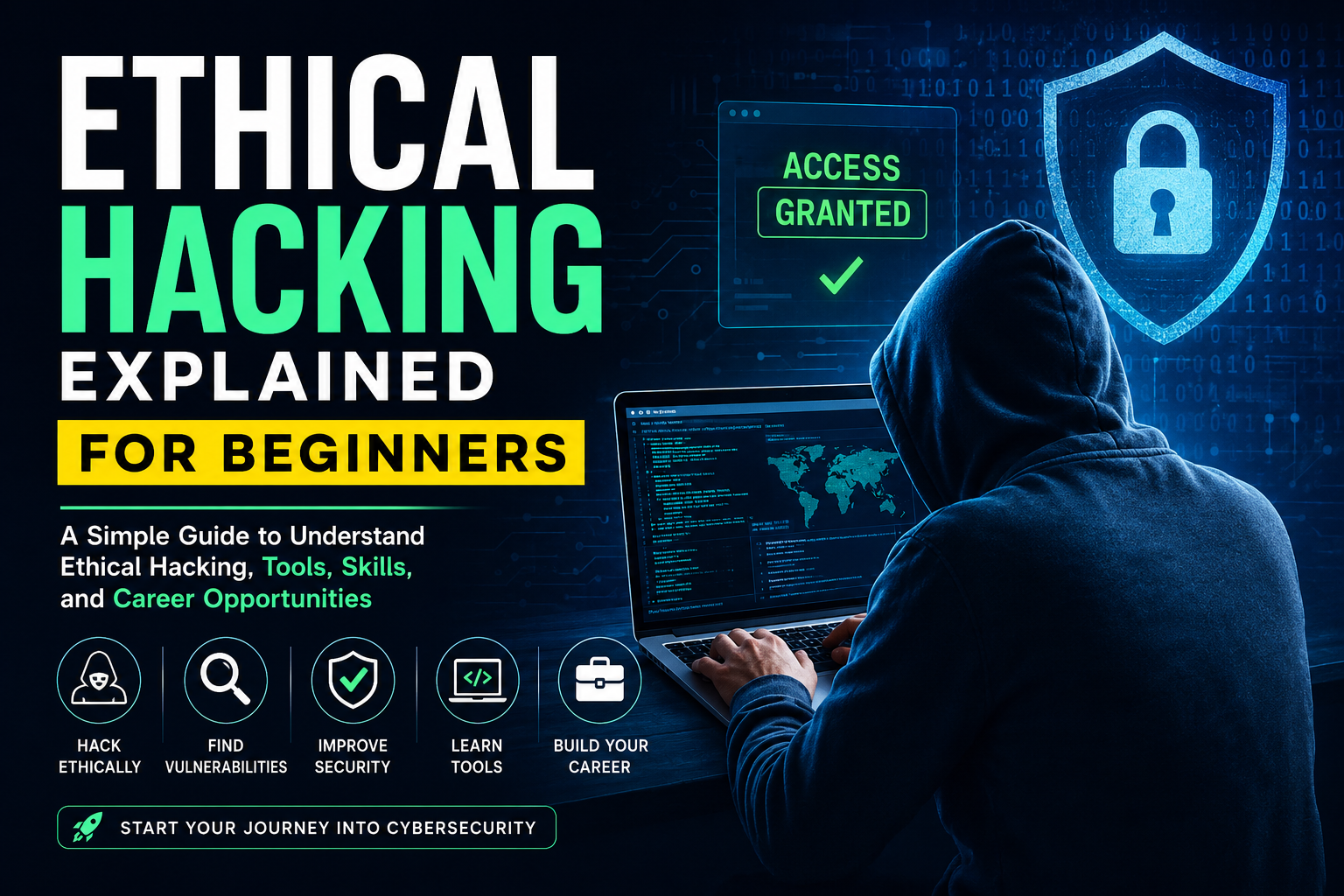
If you’re curious about cybersecurity or considering a career in ethical hacking, this beginner’s guide will explain everything you need to know.
What is Ethical Hacking?
Ethical hacking is the legal practice of testing computer systems, applications, networks, and websites to identify security weaknesses before malicious hackers can exploit them.
Ethical hackers, often called white hat hackers, work with permission from the organization to simulate real-world cyberattacks.
Their goal is simple:
- Find vulnerabilities
- Report them
- Help fix them
- Improve overall cybersecurity
Instead of causing harm, ethical hackers strengthen digital security.
Simple Definition
Think of ethical hackers as professional security inspectors.
Just as a locksmith checks whether your doors can be broken into, ethical hackers test whether hackers can break into computer systems.
Why is Ethical Hacking Important?
Cyberattacks are becoming more sophisticated every year.
Businesses, governments, hospitals, schools, banks, and even individuals face threats such as:
- Data breaches
- Identity theft
- Financial fraud
- Ransomware
- Website hacking
- Cloud attacks
Ethical hacking helps organizations:
- Prevent cyberattacks
- Protect customer data
- Meet compliance requirements
- Reduce financial losses
- Improve system security
- Build customer trust
Types of Hackers
Understanding the different categories of hackers helps explain why ethical hacking matters.
1. White Hat Hackers
These are ethical hackers.
They work legally with permission to improve cybersecurity.
2. Black Hat Hackers
These hackers illegally access systems to:
- Steal data
- Spread malware
- Commit fraud
- Demand ransom
- Damage businesses
3. Gray Hat Hackers
Gray hat hackers operate between white and black hats.
They may access systems without permission but usually don’t have malicious intentions.
However, their actions can still be illegal.
What Does an Ethical Hacker Do?
An ethical hacker performs various cybersecurity tasks, including:
- Penetration testing
- Vulnerability assessments
- Security audits
- Network testing
- Password security testing
- Wireless network testing
- Web application testing
- Cloud security testing
- Mobile application security testing
- Social engineering assessments (performed only with authorization)
How Ethical Hacking Works
Ethical hacking follows a structured process.
1. Planning
The organization defines:
- Scope
- Objectives
- Rules
- Authorized targets
2. Reconnaissance
The hacker gathers information about the target.
This includes:
- Domains
- IP addresses
- Technologies
- Public information
3. Scanning
Tools are used to discover:
- Open ports
- Running services
- Operating systems
- Security weaknesses
4. Exploitation
The ethical hacker attempts to safely verify whether identified vulnerabilities can be exploited.
This is done carefully to avoid disrupting systems.
5. Reporting
The final report includes:
- Discovered vulnerabilities
- Risk levels
- Evidence
- Recommended fixes
- Security improvements
Common Types of Ethical Hacking
Network Hacking
Tests routers, switches, firewalls, and network infrastructure.
Web Application Hacking
Finds vulnerabilities in websites and web applications.
Examples include:
- SQL Injection
- Cross-Site Scripting (XSS)
- Broken Authentication
- Security Misconfigurations
Mobile Application Testing
Evaluates Android and iOS apps for security flaws.
Cloud Security Testing
Assesses cloud infrastructure and configurations.
Wireless Network Testing
Checks Wi-Fi networks for weak passwords, poor encryption, and configuration issues.
IoT Security Testing
Evaluates Internet of Things devices such as:
- Smart cameras
- Smart locks
- Smart TVs
- Industrial sensors
Skills Every Ethical Hacker Should Learn
Ethical hacking requires both technical and analytical skills.
Essential skills include:
Networking
Learn:
- TCP/IP
- DNS
- HTTP/HTTPS
- VPN
- Firewalls
- Routing
Operating Systems
Become comfortable with:
- Linux
- Windows
- macOS
Linux is particularly important because many security tools run on it.
Programming Languages
Helpful languages include:
- Python
- JavaScript
- C
- C++
- Bash
- PowerShell
- SQL
Web Technologies
Understand:
- HTML
- CSS
- JavaScript
- APIs
- Databases
- Web servers
Cybersecurity Fundamentals
Study:
- Cryptography
- Authentication
- Access control
- Encryption
- Security policies
- Malware
Popular Ethical Hacking Tools
Professionals use many security tools for authorized testing and analysis, including:
- Nmap
- Wireshark
- Burp Suite
- Metasploit Framework
- Nessus
- John the Ripper
- Hydra
- OWASP ZAP
- Aircrack-ng
- Nikto
Remember: These tools should only be used on systems you are authorized to test.
Is Ethical Hacking Legal?
Yes.
Ethical hacking is legal only when you have explicit permission from the system owner.
Without authorization, attempting to access or test someone else’s systems may violate the law, even if your intentions are good.
Always ensure you have written approval before conducting any security testing.
Certifications for Ethical Hackers
Professional certifications can strengthen your knowledge and improve career prospects.
Popular certifications include:
- Certified Ethical Hacker (CEH)
- CompTIA Security+
- CompTIA PenTest+
- GIAC Penetration Tester (GPEN)
- Offensive Security Certified Professional (OSCP)
- Certified Information Systems Security Professional (CISSP) for experienced professionals
Career Opportunities in Ethical Hacking
Ethical hacking is one of the fastest-growing fields in technology.
Common job roles include:
- Ethical Hacker
- Penetration Tester
- Cybersecurity Analyst
- Security Consultant
- Security Engineer
- Incident Response Analyst
- SOC Analyst
- Vulnerability Assessment Specialist
- Cloud Security Engineer
- Application Security Engineer
How Much Do Ethical Hackers Earn?
Salaries vary based on experience, certifications, location, and employer.
In many regions, entry-level professionals earn competitive salaries, while experienced ethical hackers and penetration testers can command significantly higher compensation. Specialists working in finance, healthcare, cloud security, or consulting often earn premium rates.
How to Become an Ethical Hacker
If you’re starting from scratch, follow this roadmap:
Step 1
Learn computer fundamentals.
Step 2
Understand networking.
Step 3
Learn Linux.
Step 4
Study programming.
Step 5
Learn cybersecurity concepts.
Step 6
Practice in legal training environments and labs designed for learning cybersecurity.
Step 7
Study penetration testing methodologies.
Step 8
Earn relevant certifications.
Step 9
Build a portfolio by documenting your lab work, write-ups, and projects.
Step 10
Apply for internships and entry-level cybersecurity roles.
Benefits of Ethical Hacking
Ethical hacking offers many advantages:
- High demand worldwide
- Excellent career growth
- Competitive salaries
- Continuous learning opportunities
- Ability to help protect organizations
- Work in diverse industries
- Opportunities for freelance consulting and bug bounty programs
Challenges of Ethical Hacking
Like any profession, ethical hacking has its challenges.
These include:
- Constantly evolving cyber threats
- Continuous learning requirements
- Complex technologies
- High responsibility
- Pressure during security incidents
- Keeping up with new attack techniques and defenses
Ethical Hacking vs. Malicious Hacking
| Ethical Hacking | Malicious Hacking |
|---|---|
| Legal and authorized | Illegal and unauthorized |
| Improves security | Exploits vulnerabilities |
| Protects organizations | Causes harm or theft |
| Reports vulnerabilities responsibly | Conceals attacks |
| Follows professional ethics | Violates laws and policies |
Best Resources for Learning Ethical Hacking
Beginners can deepen their knowledge through:
- Cybersecurity books
- Online courses
- Official documentation
- Security blogs
- Capture-the-Flag (CTF) competitions
- Practice labs
- Community forums
- Cybersecurity conferences and webinars
Focus on resources that emphasize defensive security, responsible disclosure, and legal practice.
Frequently Asked Questions (FAQs)
Can beginners learn ethical hacking?
Yes. Anyone willing to study networking, operating systems, programming, and cybersecurity fundamentals can begin learning ethical hacking.
Do I need to know programming?
Programming is highly beneficial, especially Python and scripting languages, but you can start by learning networking and security concepts first.
Is ethical hacking a good career?
Yes. Cybersecurity professionals are in high demand worldwide, and ethical hacking offers excellent career opportunities with strong long-term growth.
Can ethical hackers work remotely?
Yes. Many organizations hire remote penetration testers, security consultants, and cybersecurity analysts.
Is ethical hacking difficult?
It can be challenging because technology evolves quickly, but consistent practice and continuous learning make it achievable for motivated learners.
Final Thoughts
Ethical hacking plays a critical role in protecting organizations from modern cyber threats. By legally identifying and helping fix vulnerabilities, ethical hackers strengthen the security of websites, applications, networks, and cloud environments before attackers can take advantage of them.
For beginners, the journey starts with learning the fundamentals of networking, operating systems, programming, and cybersecurity. With steady practice, hands-on experience in authorized environments, and a commitment to ethical conduct, you can build a rewarding career in one of the world’s fastest-growing technology fields.
Whether your goal is to become a penetration tester, cybersecurity analyst, or security consultant, ethical hacking offers exciting opportunities to make a real impact while helping keep the digital world safer.